


From Quantum Technology to Real-World Applications
One of the most fundamental measurements in photonics has become an enterprise component, and it is now the physical layer beneath five capabilities enterprises are already budgeting for.
A single photon detector performs one of the smallest measurements in physics. It registers the arrival of a single particle of light and records the precise moment it arrived, which is about as fine-grained as observation gets. What was built as an instrument for the laboratory has become a component, and that component now sits inside security infrastructure, sensing systems and production instrumentation carrying ordinary procurement codes, ordinary service contracts and ordinary uptime expectations.
Wherever a signal is too faint to average, too fast to sample, or too valuable to protect with mathematics alone, something is counting photons. Here are five places where the detector is already load bearing.
1.Secure links between data centers
A quantum key distribution link protects one specific route: two data centers in the same city, a trading floor and its disaster recovery site, headquarters and its regulator. The protection does not rest on a mathematical problem being hard to solve. It rests on the physical fact that a photon cannot be measured without being disturbed, so an interception announces itself.
What makes this an enterprise conversation rather than a research one is that these links now run on ordinary telecom fiber. In April 2026 India’s National Quantum Mission demonstrated 1,000 km of chained secure communication, with individual links reaching 200 km over standard fiber and quantum signals sharing the same strand as 10 Gbps classical traffic. The detector Is one of the blocks in the communication link that sets the per-link reach. Every extra decibel of loss a link can tolerate before the error rate becomes unusable is a direct function of how few false counts the detector produces.
2.Telecom backbones and sovereign networks
Operators, defense establishments and government departments are now procuring quantum-secured routes as infrastructure rather than as pilots. Infrastructure means hundreds of nodes rather than two, published service intervals, spares held locally, remote monitoring and an audit trail. A detector that arrives with a cryogenic plant attached is not a serious candidate for a telecom exchange or a substation, whatever its specification sheet says.
3.Entropy for cryptographic systems
Every key your organization generates rests on a source of randomness, and most of those sources are pseudo random algorithms seeded by hardware you trust rather than verify. This results in pseudo random number generation. A quantum random number generator replaces the assumption with a measurement. A photon takes one path or another, and a detector records which one. That output feeds hardware security modules, key management systems, and certificate issuance. The same need for high-quality entropy applies to post-quantum cryptography, where strong random number generation remains fundamental to generating cryptographic keys. The detector is where the quantum event becomes a measurable signal. Its performance directly affects the quality and throughput of the randomness generated.
4.LiDAR for autonomy, inspection and metrology
Direct time-of-flight LiDAR measures distance by timing a returning photon, so the detector’s timing jitter converts straight into depth uncertainty at roughly 0.15 mm per picosecond. That matters in autonomous vehicles and in the less publicized places automation is actually paying for itself: port and mining equipment, drone inspection of power lines, rail and bridges, and dimensional metrology on a production line. These are free-running measurements, because the arrival time is the unknown you are trying to recover.
5.Low-light industrial and life-science instrumentation
Semiconductor defect inspection, fluorescence lifetime instruments, environmental and gas sensing and non-destructive testing are all photon-starved measurements. When a signal consists of just a handful of photons, detection efficiency and dark counts can determine how long a scan takes. In a fab or diagnostics laboratory, that scan time directly translates into throughput and capacity.
What the five have in common
In these kind of cases the detector sets the ceiling. Reach per QKD link, secure key rate, entropy rate, depth resolution and scan throughput are all capped by the same component, and none of them can be recovered further up the stack by better software or a faster processor. It is also, in most systems sold today, the imported part, which makes it the item with the longest lead time and the least visible supply chain.
For the buyer, three questions follow. Which of my long-lived assets is already a photon-counting problem. If I purchase a system, who manufactures the detector inside it and can I have it serviced. And does the environment I am deploying into realistically support cryogenic cooling, which for a rack, a substation or a vehicle it does not.
Where we fit
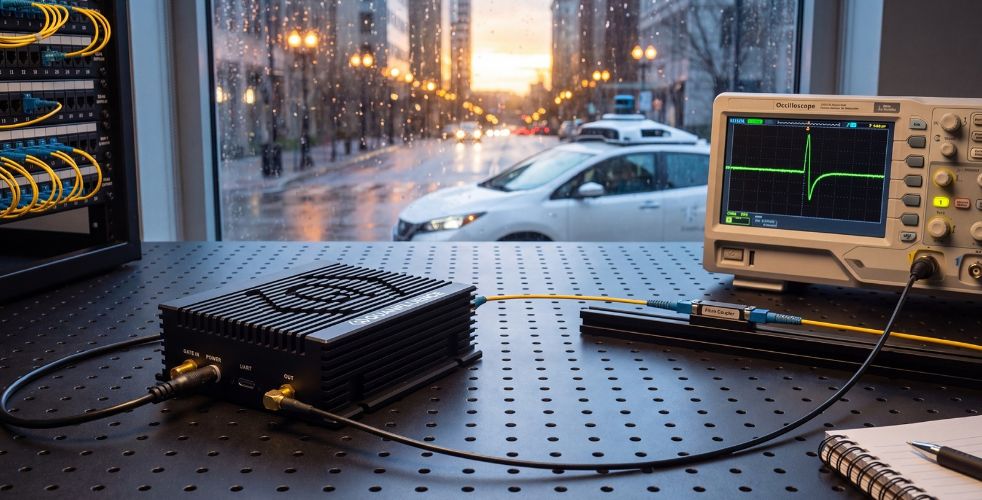
Quanfluence builds single photon detectors in India for exactly these deployments. The module is SPAD based with active quenching, runs in both gated and free-running modes, is thermoelectrically cooled to around −40 °C with no cryogenic infrastructure, occupies less than 1U height, and carries a patent-pending integrated time tagger so that the timestamp is produced inside the detector rather than in a second box down a cable. Detailed specifications are available on request.
If you are scoping a secure link, an entropy source or a sensing deployment and want to understand what the detector will cost you in reach, rate or resolution, we are happy to work through it with you at quanfluence.com